How Breathwork Supports Nervous System Regulation
Breathwork for nervous system regulation works by directly influencing the autonomic nervous system through conscious control of the breath. Slow, deliberate breathing activates the parasympathetic branch, which lowers heart rate, reduces cortisol, and shifts the body out of a fight-or-flight state. With consistent practice, this response becomes easier to access in everyday moments of stress.
What exactly is the autonomic nervous system and why does it matter?
The autonomic nervous system is the body’s largely unconscious control system, governing heart rate, digestion, hormonal output and the stress response. It has two main branches: the sympathetic system, which prepares you to respond to threat, and the parasympathetic system, which returns you to rest and repair. Most people living with chronic stress spend far too much time in sympathetic dominance, and that imbalance shows up in the body in countless ways, from disrupted sleep and tight muscles to anxious thoughts and digestive complaints.
The breath is the one autonomic function you can also control voluntarily. That single fact is what makes breathwork such a powerful entry point into nervous system regulation. You cannot consciously lower your cortisol or slow your heart rate directly, but you can change how you breathe, and those changes send an immediate signal to the brain that it is safe to soften.
How does breathwork for nervous system regulation actually work in the body?
Breathwork for nervous system regulation works primarily through the vagus nerve, the longest cranial nerve in the body, which runs from the brainstem down through the heart, lungs and gut. Slow, extended exhalations stimulate the vagus nerve, increasing what researchers call vagal tone. Higher vagal tone is associated with greater emotional resilience, more flexible stress responses and a calmer baseline state.
A commonly studied pattern is extended exhale breathing, where the out-breath is made longer than the in-breath. For example, inhaling for four counts and exhaling for six or eight counts reliably shifts the heart into a rhythm called heart rate variability coherence. Research published in the journal Frontiers in Human Neuroscience found that slow-paced breathing at around five to six breath cycles per minute produced significant reductions in self-reported anxiety and measurable changes in autonomic function in healthy adults.
Another well-documented practice is box breathing, used by the US Navy SEALs as a tool for rapid stress recovery. It involves equal counts for inhale, hold, exhale and hold again, typically four counts each. The structured rhythm gives the mind a concrete anchor, making it easier to interrupt a runaway stress response mid-moment rather than waiting for the wave to pass on its own.
What is particularly meaningful for anyone working holistically is that the breath also reaches the body’s interoceptive network, the internal sensing system that registers how we feel from the inside. Many people who carry old emotional pain, unprocessed grief or long-held tension in the body have become partially disconnected from their interoceptive signals. Gentle, conscious breathwork begins to rebuild that inner awareness, which is why it shows up so naturally alongside somatic and energetic healing modalities.
What are the most accessible breathwork techniques to start with?
The most accessible breathwork techniques for nervous system regulation are those that require no equipment, no particular fitness level and no prior experience. Extended exhale breathing, box breathing and diaphragmatic breathing are three solid starting points that most people can practise within minutes of learning them.
Diaphragmatic breathing, sometimes called belly breathing, is foundational. Most adults breathe shallowly into the upper chest, which keeps the sympathetic nervous system gently activated as a background hum. Shifting to a full diaphragmatic breath, where the belly rises on the inhale and softens on the exhale, immediately changes the mechanics of the breath and, with it, the chemistry of the stress response.
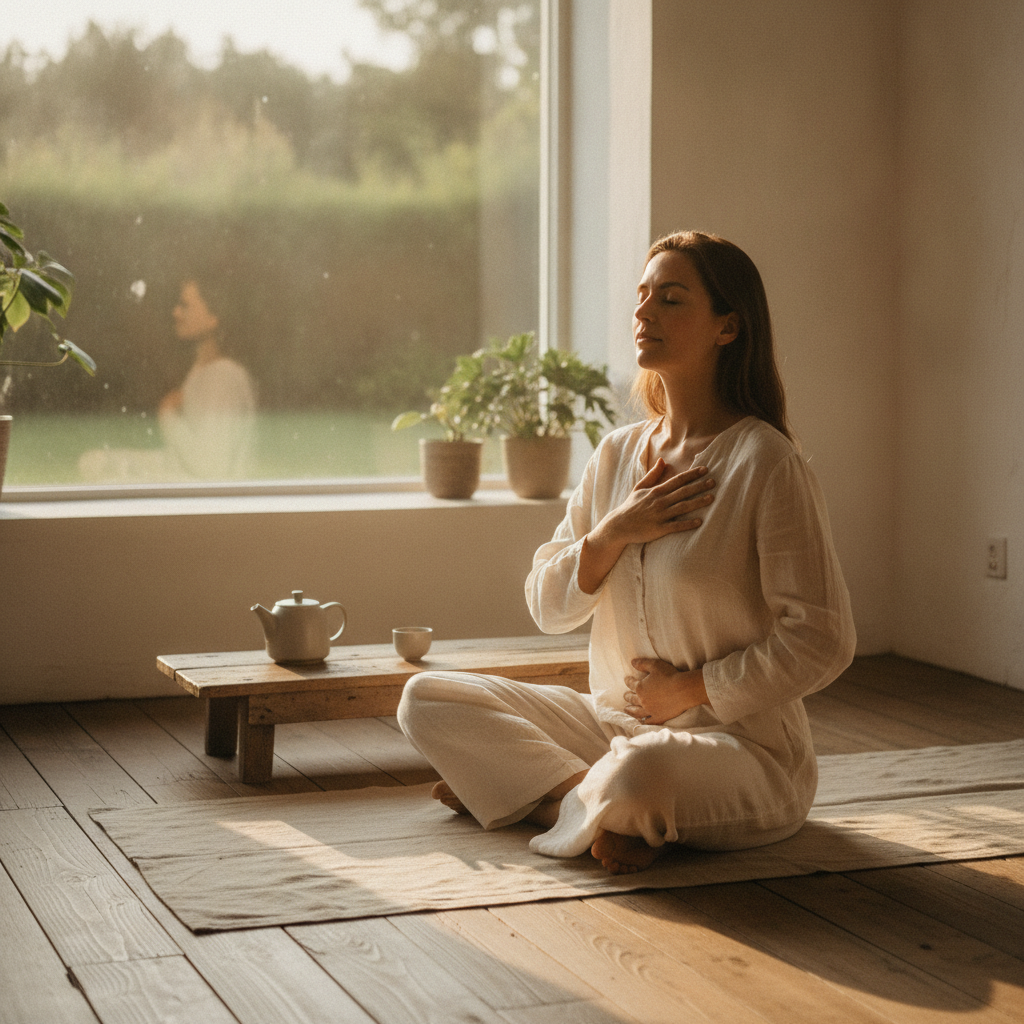
A simple way to begin: lie or sit comfortably, place one hand on the chest and one on the belly. On the inhale, allow the belly hand to rise while the chest hand stays relatively still. On the exhale, let the belly fall. Even three to five minutes of this kind of breathing, practised daily, begins to shift the nervous system’s resting baseline over time.
If you notice that focusing on the breath brings up discomfort or a sense of constriction, that is worth paying attention to rather than pushing through. For some people, particularly those with a history of trauma or anxiety, breath-focused practices benefit from being introduced gently and in a supported context. Moving slowly and pausing when something feels too intense is always the right approach.
How does breathwork fit alongside holistic and somatic healing work?
Breathwork fits naturally alongside holistic and somatic healing because it operates at the same intersection: the relationship between the body, the nervous system, the emotions and the mind. It does not treat breathwork and body-based healing as separate lanes. They run alongside each other and often deepen each other’s effects.
When the nervous system is regulated, the body becomes more available to feel, process and release what it has been holding. Many people who engage in energy-based or emotion-focused healing work notice that their sessions feel more spacious and their insights land more easily when they are also caring for their nervous system through the breath. Regulation is not the end goal. It is the ground from which deeper healing becomes possible.
This is part of why breathwork appears as a core element within yoga therapy, which integrates classical yogic practices including pranayama (breath control) with an understanding of the whole person. Yoga therapy draws on the breath not just as a physical tool but as a bridge between the body’s physical experience and its emotional and energetic layers. It is a lens through which breathwork becomes genuinely integrative rather than simply a relaxation trick.
Building a personal breathwork practice does not have to be complicated or time-consuming. A few intentional minutes at the start of the day, before a difficult conversation or at the close of the evening can be enough to begin shifting how your nervous system responds to daily life. The key is consistency over intensity: small, regular practice tends to create more lasting change than occasional longer sessions.
If you would like to explore breathwork within a structured, therapeutic and personalised context, Book a Yoga Therapy session with Zoe Bentley Healing to practise regulating breathwork.