What Is Zenthai Shiatsu and How Does It Compare to Yoga Therapy?
Zenthai shiatsu is a bodywork modality that blends Japanese shiatsu, Thai massage, Zen principles and yogic philosophy into one floor-based, clothed treatment. Practitioners work along meridian lines and energy pathways to release physical tension and support emotional wellbeing. Yoga therapy, by contrast, uses breath, posture and guided inquiry to help you actively participate in your own healing.
What exactly is zenthai shiatsu, and what happens in a session?
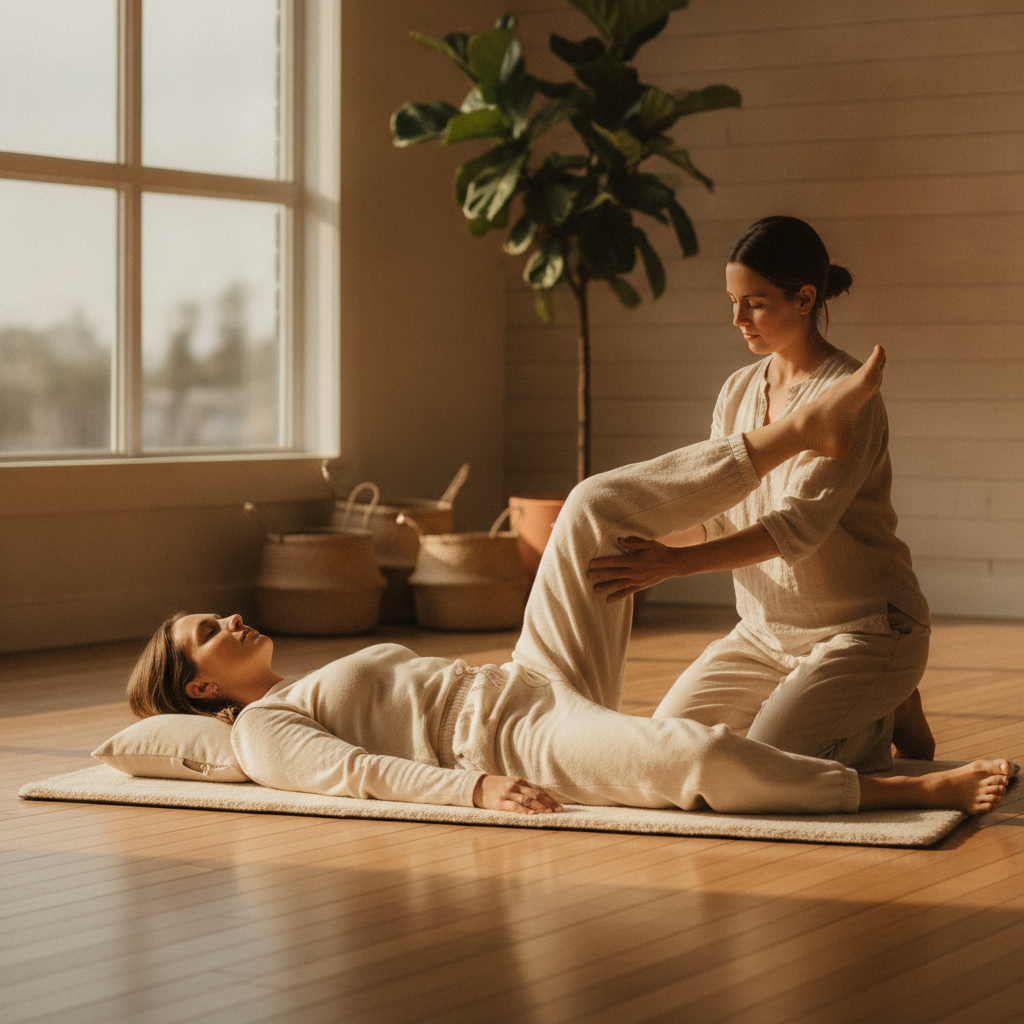
Zenthai shiatsu is a hands-on healing practice developed in Australia by Gwyn Williams in the 1980s. A session takes place on a floor mat, with the recipient fully clothed. The practitioner uses palm pressure, thumbwork, assisted stretches drawn from Thai massage and gentle joint mobilisation to move energy through the body’s meridian system, aiming to restore balance across physical, emotional and energetic layers.
The modality draws from four distinct traditions. Shiatsu contributes its focus on the meridian system, the same energetic map used in traditional Chinese medicine. Thai massage adds rhythmic compression and assisted yoga-like stretches that encourage deep tissue release and improved circulation. Zen philosophy shapes the quality of presence a practitioner brings, slow, meditative and deeply attuned. Yogic philosophy threads through the understanding of prana, the life force that moves through the body and underpins how we feel day to day.
People who seek out zenthai shiatsu sessions often describe a particular quality of rest that follows: a kind of settling that is deeper than ordinary relaxation. Chronic muscular tension, stress held in the hips and shoulders, digestive sluggishness and a generalised sense of being “stuck” are the kinds of experiences people bring to the practice. Because it is performed clothed on a mat, it tends to feel accessible even to those who feel hesitant about conventional massage.
Zenthai shiatsu courses and retreats have grown steadily across Australia and internationally. Training programmes typically run over several years and cover anatomy, traditional Chinese medicine theory, Thai body mechanics and the meditative aspects of Zen practice, which is part of why practitioners who train in it often describe the modality as a personal transformation journey as much as a professional one.
How does zenthai shiatsu therapy differ from yoga therapy?
The core difference is one of activity versus receptivity. In zenthai shiatsu, the practitioner does the moving: you lie on a mat, breathe, and receive. In yoga therapy, you are the active participant, guided to use specific postures, breathwork (pranayama) and awareness practices to work with your own nervous system, structural patterns and emotional landscape. Both are therapeutic and both honour the connection between body, mind and energy, but they ask different things of you in the session.
Yoga therapy is recognised by the International Association of Yoga Therapists (IAYT) as a distinct clinical discipline, separate from group yoga classes. A yoga therapist conducts an initial intake, identifies the patterns that are contributing to a person’s difficulty, and designs a personalised practice. Sessions can address musculoskeletal concerns, anxiety, chronic fatigue, trauma responses and more. The client is an active co-creator of their own healing rather than a passive recipient.
This is perhaps the most meaningful distinction for someone deciding between the two approaches. If your nervous system is so depleted or dysregulated that active participation feels like too much, the quiet receptivity of a zenthai shiatsu session may be what your body is asking for first. If you are ready to develop tools you can take home and use between sessions, yoga therapy offers exactly that: practices that become part of your daily life rather than something that only happens on a practitioner’s table.
It is also worth noting that the two modalities are not mutually exclusive. Many people who work with a yoga therapist also receive bodywork of various kinds and find the two approaches layer together beautifully. The zenthai shiatsu session softens the physical body; the yoga therapy session helps you learn to listen to it and work with it consciously.
Who tends to benefit most from zenthai shiatsu retreats and courses?
People drawn to zenthai shiatsu retreats and courses often share a few qualities: a curiosity about the body as more than a mechanical structure, some existing interest in yoga or meditation, and a sense that something in them needs addressing at a deeper level than a standard massage can reach. Retreat settings are particularly powerful because the immersive environment removes the interruptions of everyday life and allows the nervous system to genuinely settle over several days.
Practitioners in training also report that studying zenthai shiatsu shifts how they inhabit their own bodies. Learning to give a treatment from a meditative, present-centred state inevitably becomes a practice in self-awareness. This is one of the reasons the modality attracts people who are already working in health and wellness fields and are looking to expand their offering.
From an educational perspective, zenthai shiatsu courses are taught across Australia in cities including Byron Bay, Melbourne and Sydney, as well as in retreat centres overseas. Foundation modules typically introduce meridian theory, basic floor techniques and breath awareness, making them accessible even to people without a bodywork background.
How does energy-based bodywork connect to holistic counselling and emotional healing?
Both zenthai shiatsu and yoga therapy rest on the understanding that the body stores experience. Tension in the hips may correspond to unprocessed grief or fear held in the kidneys and bladder meridians, according to traditional Chinese medicine theory. A shoulder that never quite releases may be carrying a long-held burden. When the physical body is met with presence and skilled attention, whether through touch or therapeutic movement, emotional material sometimes surfaces naturally.
This is where the wider field of body-based and energy healing becomes relevant. Approaches like the Emotion Code, the Body Code and holistic counselling all proceed from a similar premise: that the body and subconscious mind hold imprints of our experience, and that gently working with those imprints can produce meaningful shifts in how we feel and how we move through the world. These modalities do not require you to talk through every detail of a difficult experience; instead they offer ways to address what is held in the system at an energetic and somatic level.
If you have explored zenthai shiatsu massage, yoga retreats or courses and found yourself intrigued by the way the body stores and releases emotion, that thread is worth following. Understanding the body as an intelligent, feeling system, rather than a problem to be fixed, is at the heart of all genuinely holistic healing work.
Book a Yoga Therapy session with Zoe Bentley Healing to explore body-based healing.