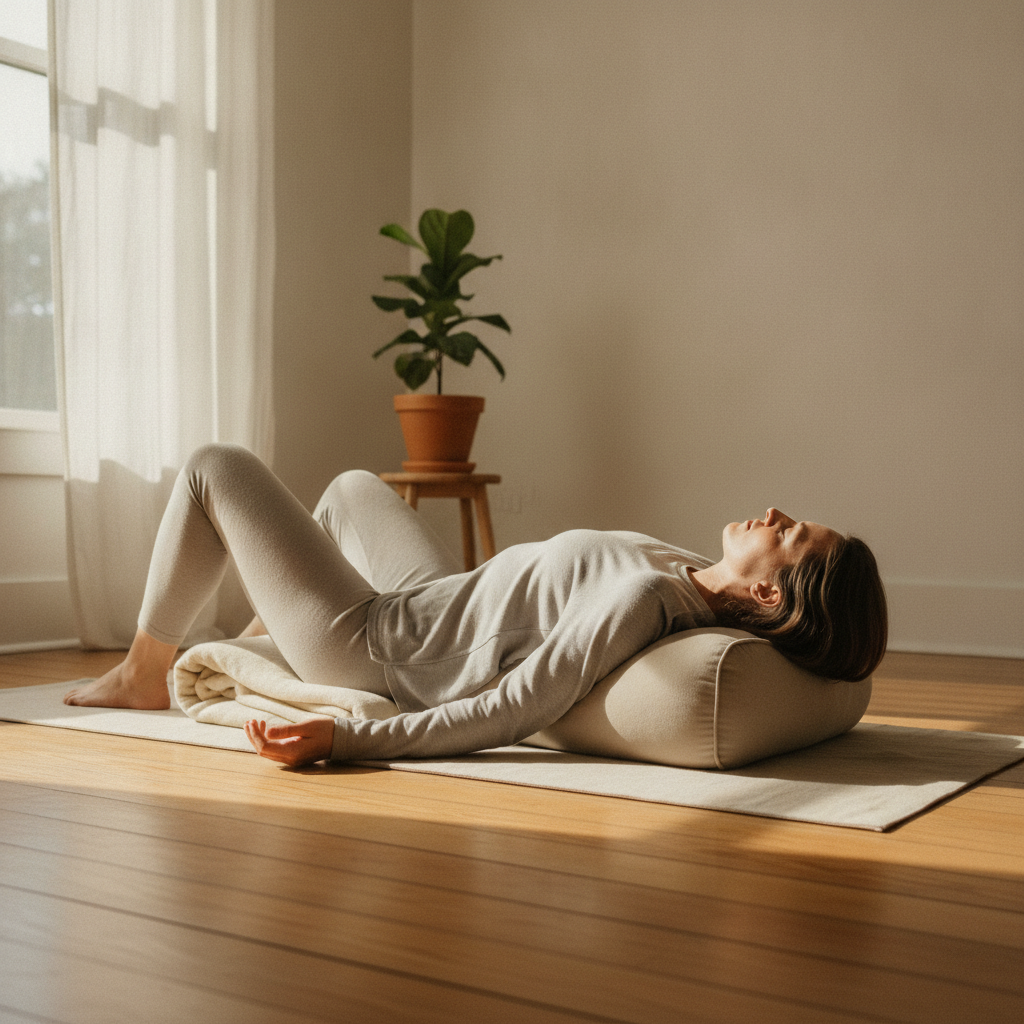
How Yoga Supports Nervous System Regulation
Yoga for nervous system regulation works by activating the parasympathetic branch of the autonomic nervous system, slowing the breath, reducing cortisol, and signalling safety to the body. A consistent practice, especially one that blends breathwork, gentle movement and stillness, can meaningfully shift how your body responds to everyday stress over time.
What does the nervous system actually do, and why does it get dysregulated?
The autonomic nervous system runs quietly in the background, governing your heart rate, digestion, immune function and your instinctive responses to threat. It has two main branches: the sympathetic system, which accelerates your body into fight-or-flight, and the parasympathetic system, which brings you back to rest and repair. When life is consistently demanding, or when your body has stored old stress and trauma, the sympathetic branch can become the default setting. You might notice this as a low hum of anxiety, poor sleep, digestive upsets, a feeling of being perpetually on edge, or a kind of flat numbness that polyvagal researchers call the dorsal vagal shutdown state.
The key insight from contemporary neuroscience is that the nervous system is not fixed. It is shaped by repeated experience, and that means it can be gently, reliably retrained.
How does yoga for nervous system regulation actually work in the body?
Yoga for nervous system regulation works through several overlapping pathways: slow, extended exhalations stimulate the vagus nerve directly; physical postures release muscular tension held as a byproduct of the stress response; and the sustained attention required by mindful movement quiets the default mode network, reducing rumination. Together these pathways shift the body toward a parasympathetic state.
The vagus nerve is the longest cranial nerve in the body, running from the brainstem all the way to the abdomen and touching nearly every major organ on the way. Research published in journals including the International Journal of Yoga has consistently shown that slow diaphragmatic breathing, the kind cultivated in yoga practice, increases heart rate variability (HRV), a widely used marker of how flexibly the nervous system can move between activation and calm. Higher HRV is associated with better emotional regulation, greater resilience and lower baseline anxiety.
Specific practices are worth naming here. A 4-count inhale followed by a 6 or 8-count exhale, often called extended exhale breathing or coherence breathing, is one of the most researched techniques for vagal stimulation. Restorative postures held for several minutes, supported by props, encourage the connective tissue to release and send safety signals back to the brain via interoceptive nerve pathways. Yoga nidra, a guided body-scan practice done in stillness, has been studied in clinical contexts and shown to reduce sympathetic arousal markers including elevated heart rate and muscle tension within a single session.
What is the difference between a general yoga class and yoga therapy for nervous system support?
A general yoga class offers movement, breath and community, all of which genuinely support nervous system health. Yoga therapy goes further by tailoring the practice to an individual’s specific patterns, history and nervous system state. Rather than following a class sequence, a yoga therapist works with you one-to-one to identify what your system needs and builds practices around that, which can make a significant difference when dysregulation runs deep.
For someone whose nervous system is stuck in chronic high arousal, a vigorous vinyasa class can sometimes increase activation rather than ease it. For someone in a dorsal vagal freeze state, passive restorative work alone might not provide enough gentle stimulation to create movement. This is where individualised yoga therapy becomes genuinely useful. A trained yoga therapist can read these signals and adjust the approach, blending breathwork, movement, sound, guided awareness and somatic practices in a way that meets your system where it actually is.
Yoga therapy is recognised by the International Association of Yoga Therapists (IAYT) as a distinct professional discipline, separate from yoga instruction, with its own training standards and scope of practice. Sessions are typically more conversational, slower paced and collaborative than a studio class.
What kinds of experiences benefit most from yoga for nervous system regulation?
People who find yoga-based nervous system work especially supportive often describe experiences like chronic stress or burnout, anxiety that feels physically held in the body, difficulty switching off or sleeping, recovery from illness where the body still feels guarded, and a general sense of being disconnected from themselves. It is also used as a complement to psychological or medical care for post-traumatic stress, though it is always positioned as a supportive practice rather than a replacement for professional healthcare.
One of the beautiful things about approaching the nervous system through the body rather than purely through the mind is that it sidesteps the need to talk through everything. The body keeps its own record, and sometimes the most direct route to feeling safer in yourself is through breath and movement rather than words alone. This is why somatic and body-based approaches have gained so much attention in the last decade, with practitioners like Dr Bessel van der Kolk and Stephen Porges bringing the science of body-based healing to a much wider audience.
How can you begin building a nervous-system-informed yoga practice?
Beginning is simpler than it might seem. You do not need an hour on a mat every day. Even five to ten minutes of intentional breath and movement, done consistently, begins to lay down new neural pathways. Start by extending your exhale so it is at least as long as your inhale, and ideally a little longer. Pair this with slow, repetitive movement, cat and cow, gentle spinal rotation, or simply rocking, that gives your nervous system rhythm and predictability to orient around.
Over time you can build in longer practices: a 20-minute restorative sequence before bed, a morning yoga nidra, or a weekly session with a yoga therapist to deepen and personalise the work. The goal is not perfect postures. The goal is helping your body learn, through repeated experience, that it is safe to settle.
Consistency matters far more than intensity here. The nervous system responds to patterns. Each time you move through a practice and arrive at a moment of genuine stillness or ease, you are teaching your body that this state is available. Over weeks and months, that learning accumulates.
At Zoe Bentley Healing, yoga therapy sessions are offered as part of a holistic approach to wellbeing, woven together with other somatic and energy-based modalities to support you as a whole person. If your nervous system has been running on high for too long, or feels like it has quietly gone offline, this kind of personalised, body-centred work can be a gentle and genuinely effective way back to yourself.
Book a Yoga Therapy session with Zoe Bentley Healing for nervous system support