If you have been curious about chakra balancing but are not quite sure what to expect or whether it is right for you, you are not alone. Many people come to their first energy healing session with a mix of openness and uncertainty. This guide walks you through everything a first-timer genuinely needs to know: what chakra balancing involves, what actually happens during a session, what the research does and does not say, how much it typically costs in Australia, and how to find a practitioner you can trust.
Whether you are drawn here by ongoing stress, emotional heaviness, or simply a desire to explore holistic wellbeing, read on for a grounded, honest introduction.
- Key takeaways
- Chakra balancing is a complementary wellness practice, not a medical treatment. It is not a substitute for professional healthcare.
- A first session typically runs 45 to 75 minutes and involves a brief intake conversation, hands-on or hands-near energy work, and time to rest and integrate afterwards.
- Common sensations include warmth, tingling, deep relaxation, or emotional release. Some people notice nothing unusual at all, and that is equally normal.
- There is currently no peer-reviewed scientific consensus confirming that chakras exist as measurable physical structures, so approach claims of guaranteed outcomes with caution.
- In Australia, energy healing is not regulated by AHPRA. Vetting your practitioner carefully is important.
- Session costs in Australia generally range from around $80 to $180 for a one-hour appointment, depending on the practitioner’s experience and modality.
What is chakra balancing?
The word “chakra” comes from Sanskrit and translates roughly as “wheel” or “circle.” In traditional Indian healing systems, chakras are described as spinning centres of energy located along the body’s central axis, from the base of the spine to the crown of the head. There are seven main chakras, each associated with particular physical areas, emotions, and qualities of experience.
Chakra balancing is the practice of working with these energy centres to restore a sense of flow and ease. Practitioners use a range of approaches, including breathwork, meditation, gentle touch, sound (such as singing bowls or tuning forks), crystals, and visualisation. The intention is to address areas that feel congested, depleted, or out of balance, and to support the body’s own capacity for rest and recovery.
For a broader look at how energy-based practices work, What Is Energy Healing? A Clear Guide for Beginners is a helpful starting point.
The seven chakras at a glance
| Chakra | Location | Commonly associated with |
|---|---|---|
| Root (Muladhara) | Base of spine | Safety, grounding, stability |
| Sacral (Svadhisthana) | Lower abdomen | Creativity, emotion, pleasure |
| Solar Plexus (Manipura) | Upper abdomen | Confidence, willpower, identity |
| Heart (Anahata) | Centre of chest | Love, compassion, connection |
| Throat (Vishuddha) | Throat | Communication, expression, truth |
| Third Eye (Ajna) | Between the eyebrows | Intuition, clarity, insight |
| Crown (Sahasrara) | Top of head | Awareness, purpose, connection to something larger |
What does the evidence actually say?
This is worth addressing honestly, because most chakra balancing websites skip over it entirely.
At this point in time, there is no peer-reviewed scientific consensus confirming that chakras exist as measurable, physical structures in the body. Research examining the scientific evidence for chakras finds that while the concept has deep roots in traditional medicine and is reported as meaningful by many practitioners and clients, it has not been validated through the methods used in clinical science.
That does not mean sessions are without value. Many people report genuine benefits: a sense of calm, reduced tension, emotional clarity, and improved sleep after energy healing sessions. These outcomes are consistent with the well-documented physiological effects of deep relaxation, mindful attention, and therapeutic touch. In other words, something real may be happening, even if the precise mechanism is still debated.
A grounded practitioner will be honest about this distinction. If someone promises to “cure” a condition or diagnose illness through chakra work, that is a red flag. Chakra balancing is a complementary practice. It sits alongside, not instead of, conventional healthcare.
Your first chakra balancing session: a step-by-step walk-through
Here is what a typical energy healing session looks like from the moment you arrive to the moment you leave. Knowing the structure in advance can help you relax into the experience rather than wondering what comes next.
Before the session
- Intake conversation (5 to 15 minutes). Your practitioner will ask about what brought you in, any areas of physical or emotional tension, and your intention for the session. You do not need a clear answer. “I just want to see how this feels” is completely valid.
- Clothing. You remain fully clothed throughout. Wear something loose and comfortable. Avoid heavy jewellery or tight waistbands if you can.
- Practical prep. Eat lightly beforehand rather than on a full stomach. Drink water. Arrive a few minutes early so you are not rushing.
During the session (typically 45 to 60 minutes of table time)
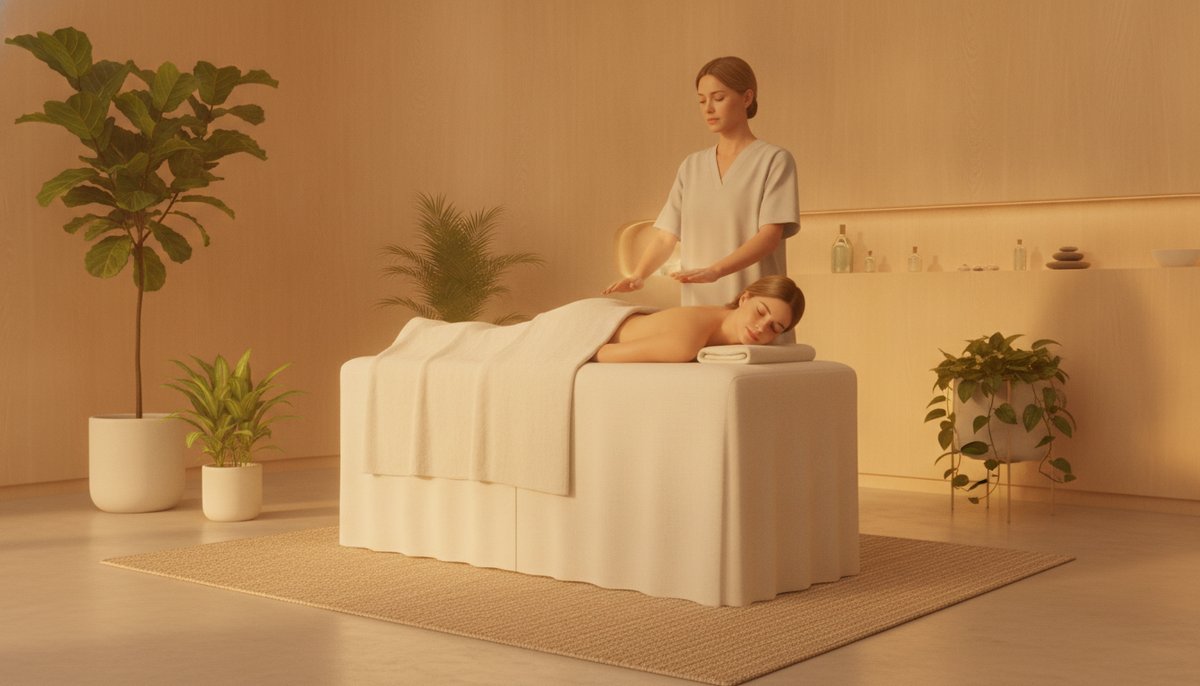
- You will lie down on a comfortable treatment table, usually on your back, with a blanket available if you want one.
- The practitioner will work either with hands resting gently on specific areas or hovering a few centimetres above the body, moving slowly from one energy centre to the next.
- Some practitioners incorporate sound (a singing bowl near the feet, for example), crystals placed on or near the body, or guided breath cues.
- There is generally very little talking during this phase. You are invited to simply rest.
- Sessions often feel deeply meditative. It is common to drift into a light sleep-like state.
What you might notice
People report a wide range of sensations, and none of them is more “correct” than another. Common experiences include:
- Warmth or gentle heat, particularly where the practitioner’s hands are working
- A sense of tingling or subtle pulsing
- Emotional waves, including unexpected tearfulness or a feeling of lightness
- Deep physical relaxation, sometimes to the point of feeling heavy or very still
- Nothing in particular, just a quiet hour of rest
All of these are normal. The absence of dramatic sensation does not mean nothing happened.
After the session
- Your practitioner will give you a few minutes to come back to full alertness before sitting up.
- There is usually a brief debrief: what they noticed, what you experienced, and any suggestions for the days ahead.
- Drink extra water for the rest of the day.
- Some people feel energised; others feel very tired and in need of an early night. Both responses are healthy.
- Emotional processing can continue over the following 24 to 48 hours. This is a normal part of integration.
For more detail on the broader experience of energy work, What Is an Energy Healing Session and What Should You Expect? covers the wider context well.
How to find a trustworthy practitioner in Australia
This is where Australian clients need specific guidance, because energy healing sits outside the framework regulated by the Australian Health Practitioner Regulation Agency (AHPRA). Unlike physiotherapy or psychology, there is no national register for chakra balancing or energy healing practitioners. That means the responsibility for vetting falls on you.
Here are practical steps to help you choose well:
- Look for professional association membership. Organisations such as the Australian Traditional-Medicine Society (ATMS) or the Australian Natural Therapists Association (ANTA) have codes of ethics and complaint processes. Membership is not a guarantee of quality, but it signals accountability.
- Ask about training. A credible practitioner will be able to tell you clearly where they trained, for how long, and what ongoing professional development they undertake.
- Read real testimonials. Look for detailed, specific feedback rather than generic five-star ratings. A practitioner who has been working with clients over time will have a track record you can assess.
- Notice how they communicate. Do they listen before they talk? Are they honest about what the practice can and cannot do? A grounded practitioner does not oversell outcomes.
- Check their terms and policies. Transparency around cancellation, privacy, and session structure is a basic professional standard.
The Natural Therapy Pages guide to energy healing in Australia provides a useful overview of the broader landscape of complementary therapists operating here.
How much does chakra balancing cost in Australia?
Costs vary depending on the practitioner’s experience, location, and whether the session is in-person or online. As a general guide:
- Single session (60 minutes): $80 to $180
- Initial extended session (75 to 90 minutes): $120 to $220
- Package bookings: Many practitioners offer a reduced rate when you book three or more sessions. This can bring the per-session cost down by 10 to 20 per cent.
- Online sessions: Often slightly less expensive than in-person appointments and can be just as effective for energy-based work.
Energy healing is generally not covered by Medicare. Some private health funds cover certain complementary therapies under extras cover, so it is worth checking your policy. If cost is a consideration, session packages can make regular sessions more accessible.
How chakra balancing fits with other holistic practices
Chakra balancing does not have to stand alone. Many people find it works well alongside other modalities that address the mind-body connection. Yoga therapy, for example, works with the breath, posture, and nervous system in ways that complement energy work directly. Some practitioners also integrate approaches like the Emotion Code or Body Code, which focus on identifying and releasing stored emotional patterns.
The key is finding a combination of practices that feels right for you, with practitioners who communicate clearly and respect your pace.
Frequently asked questions
Do I need to believe in chakras for a session to be useful?
No. Many people approach their first session with genuine scepticism and still find value in the experience of deep rest and intentional attention to how they feel. The framework of chakras is a way of organising the session, not a belief system you need to adopt. Come curious rather than committed, and let your own experience guide you.
Is chakra balancing safe?
For most people, yes. Chakra balancing is non-invasive and gentle. It is not a replacement for medical care, and a responsible practitioner will always encourage you to maintain your existing healthcare relationships. If you have a history of trauma, let your practitioner know before the session so they can work sensitively with you.
How many sessions will I need?
There is no universal answer. Some people find a single session offers useful insight or a reset. Others prefer to work over a series of sessions to address deeper patterns. A good practitioner will not push you toward more sessions than you feel ready for. Start with one and see how you feel afterwards before committing to a programme.
Can I have a chakra balancing session online?
Yes. Many energy healing practitioners offer remote sessions, and clients regularly report similar experiences to in-person appointments. You would join via video call, lie down in a comfortable space at home, and the session proceeds much as it would in a clinic. Remote work removes geographical barriers, which is particularly useful in regional and rural Australia.
What is the difference between chakra balancing and other energy healing modalities?
Chakra balancing specifically uses the seven-chakra framework drawn from Indian healing traditions. Other modalities, such as the Emotion Code or Donna Eden’s Energy Medicine, use different maps of the body’s energy system and different techniques. The underlying principle, that the body holds energy and that working with it can support wellbeing, is shared across many approaches. Speak with a practitioner about which framework resonates with you and why they work with the methods they do.
A gentle next step
Chakra balancing is, at its heart, an invitation to slow down, pay attention, and give your system space to settle. Whether you arrive carrying chronic stress, emotional weight, or simple curiosity, a well-held session offers something genuinely rare: uninterrupted time to rest and be attended to with care.
If you are ready to explore what a first chakra balancing or energy healing session might feel like for you, take a look at the services and session options at Zoe Bentley Healing. Sessions are available online, so wherever you are in Australia, support is within reach.